.png&w=1280&q=75)




I used to pride myself on being 'motivated' while secretly rewriting my plans into excuses. Most people don’t realize they’re self-sabotaging—until a pattern snaps into focus. In this short post I’ll tell you the ten tiny routines I noticed wrecking my momentum, why the brain lets them happen (spoiler: it’s trying to keep you safe), and the bite-sized fixes I actually stuck with.
1) How I Realized I Was My Own Worst Enemy
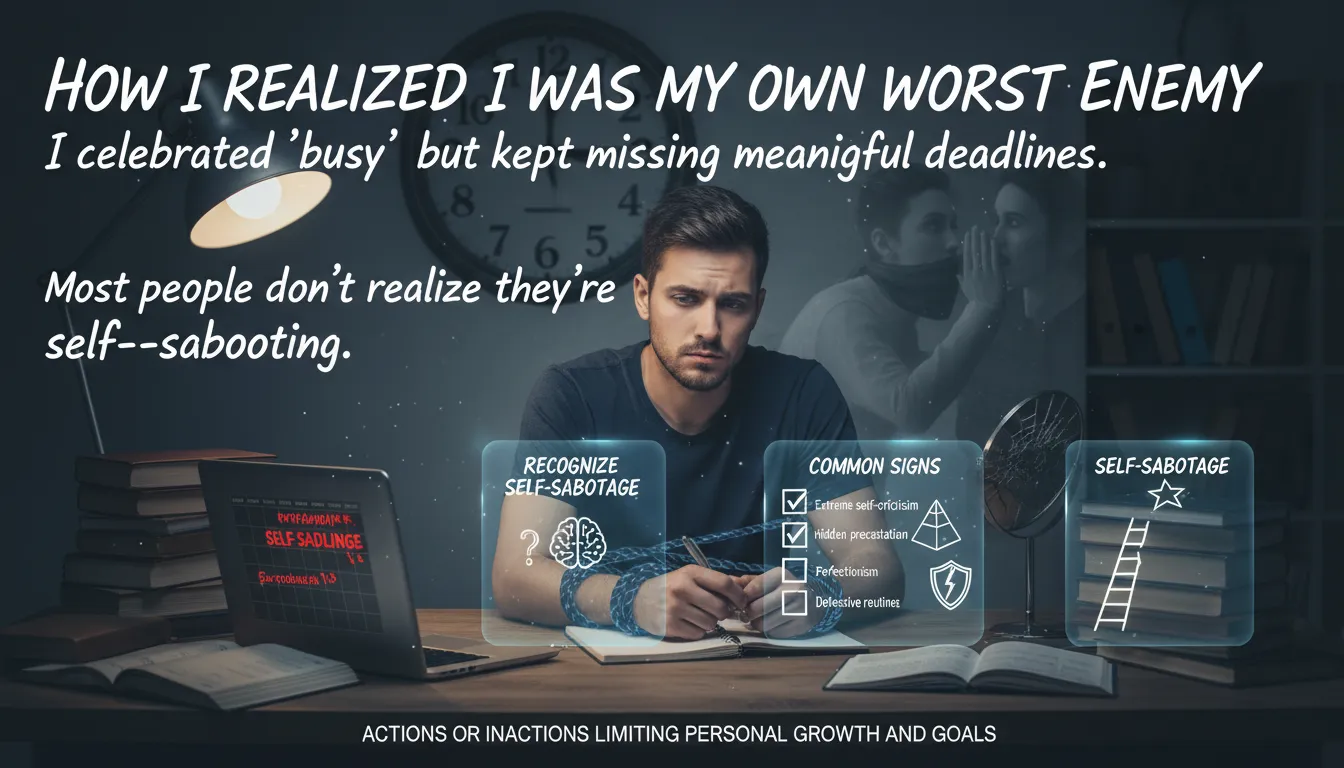
Most people don’t realize they’re self-sabotaging. I didn’t either. I wore “busy” like a badge, answered every message fast, and filled my calendar with small tasks. Yet I kept missing the deadlines that actually mattered. That’s when I started to Recognize Self-Sabotage: my “productivity” was really avoidance.
What makes Self-Sabotage go viral is simple—curiosity (“Is this me?”) plus a little fear (“What is this costing me?”) plus solutions. Mentalhealthhotline.org describes self-sabotage as actions or inactions that limit growth and goals, and that hit hard because it’s so quiet.
Common Signs I Ignored
- Extreme self-criticism after small mistakes
- Hidden procrastination (busywork instead of real work)
- Perfectionism that delays finishing
- Poor time management dressed up as “control” routines
“Self-compassion is not self-indulgence; it’s the ground from which real change grows.” — Kristen Neff
2) Procrastination & Perfectionism: The Twin Productivity Killers
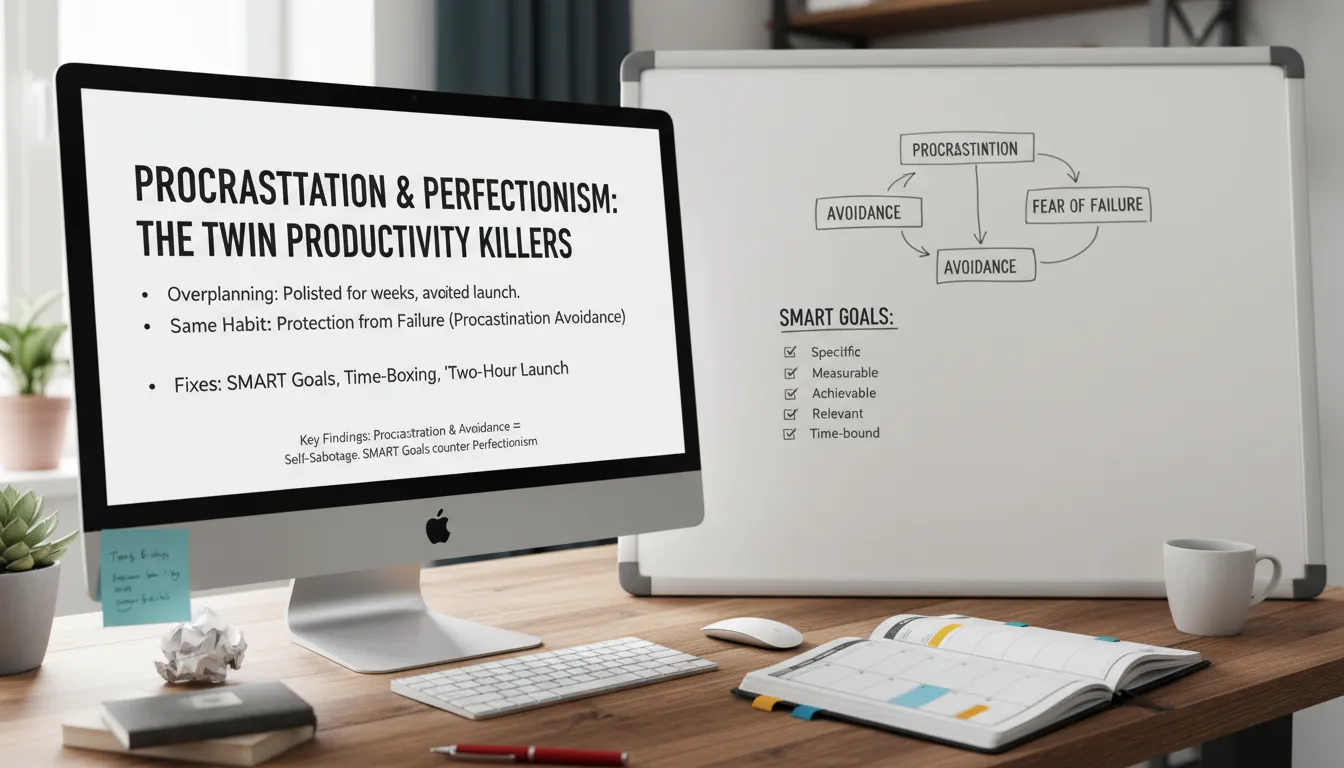
Most people don’t realize they’re self-sabotaging. I didn’t either—until I spent weeks “overplanning” a project, polishing fonts and tweaking slides, just to avoid launching it. That’s Perfectionism wearing a productive mask.
Why Procrastination Avoidance and Perfectionism are the same
Research and even HBR-style burnout insights point to this: procrastination and avoidance are top self-sabotage bad habits that stall progress. They both protect me from failure and uncertainty—classic Procrastination Avoidance.
Adam Grant: "Procrastination is often a signal — not of laziness, but of unresolved fear about the outcome."
Fixes that sparked real self-improvement
- Set Achievable Goals using SMART Goals: Specific, Measurable, Achievable, Relevant, Time-bound.
- Time-box work into 15–30 minute micro-actions, then celebrate small wins (reward loops).
- My “two-hour launch” rule: ship a version fast, then improve.
I use Habit Tracking to turn this into a real life transformation.
3) Defensive Routines, Low Self-Esteem, and Emotional Weather
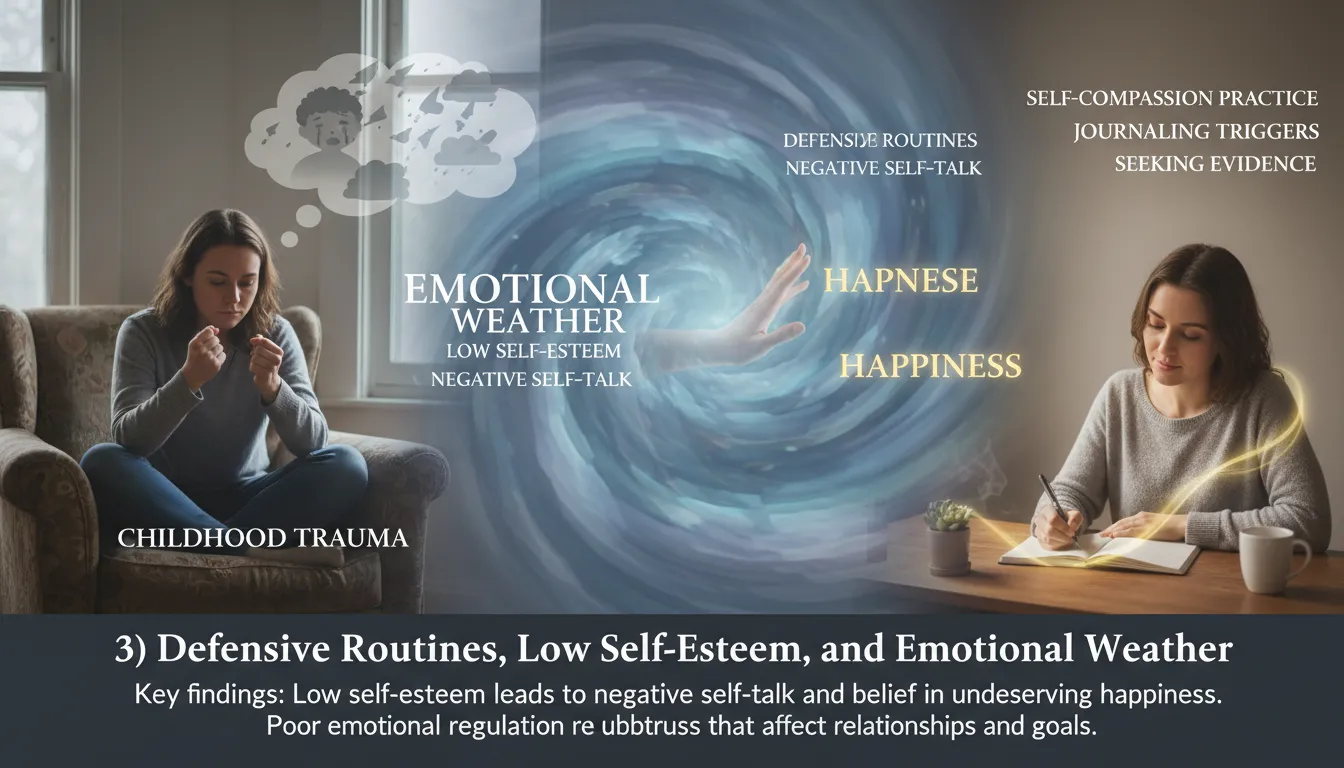
Most people don’t realize they’re self-sabotaging. I didn’t either. My Low Self-Esteem made praise feel unsafe, so I’d shrug it off, joke it away, or change the subject. It looked like confidence, but it was one of my quiet bad habits blocking real self-improvement and life transformation.
Childhood Trauma, Negative Self-Talk, and Emotional Regulation
Under stress, old scripts from Childhood Trauma kicked in: “Don’t get seen.” That fueled Negative Self-Talk and the belief I didn’t deserve happiness. When my Emotional Regulation was poor, I’d snap, withdraw, or over-explain—then wonder why relationships and goals suffered.
Susan David: "Emotional agility lets you step toward values instead of away from uncomfortable feelings."
Fix: Self Compassion in 5 Minutes
- Morning journal (5 min): “This is hard. I’m not alone. May I be kind to myself.”
- Track triggers; practice regulation 3–5x weekly (breathing, pause, name the feeling).
- Collect small evidence against the story in your head.
4) Brain Safety: Amygdala, Basal Ganglia, and the Comfort of the Known
Neuroscience Self-Sabotage: why “safe” feels better than growth
Most people don’t realize they’re self-sabotaging. When I try to change, my Brain Amygdala reads uncertainty as danger and hits the stress alarm. A News-Medical (2026-01-04) piece on the brain’s need for control explains why I crave certainty, even if it keeps my bad habits alive.
Then the Basal Ganglia steps in. It automates routines to save energy, so avoidance becomes my default. That’s how Self Handicapping shows up: I procrastinate, “forget,” or stay busy so I don’t have to risk failing. It feels like Predictability Progress, but it blocks real self-improvement and life transformation (see also HBR, 2020/11; ContemplationStation).
"The body keeps the score; our habits often echo what we learned to survive." — Bessel van der Kolk
- Design my space: swap a bad cue for a good one—keep running shoes visible.
- Use tiny, predictable routines: 5 minutes daily beats “all or nothing.”
5) Tiny Environmental Fixes, Time Management, and Burnout Risk
Most people don’t realize they’re self-sabotaging. Last weekend I tried Environment Design: I removed social apps from my phone and got +2 distraction-free hours per day. Small change, big result—and a real push toward self-improvement and life transformation.
Time Management + Habit Tracking (Overplanning Winging)
- Time Management: time-block my day (one task per block).
- Two-hour launch: start any project with 120 minutes before I “plan more.”
- Habit Tracking: I track one keystone habit for 7 days before judging it.
Burnout Risk: the “busy” trap
HBR (Nov 2020) notes chronic self-sabotage can feed burnout. My warning signs: irritability, sleep debt, and “overplanning” that turns into winging. Substance abuse can also creep in as a coping bad habit.
Arianna Huffington: "Burnout is not a badge of honor—it’s a signal to redesign your life."
Wild Cards: Imaginary Scenarios & Strange Analogies
Most people don’t realize they’re self-sabotaging. When my bad habits flare up, I get playful to build Self Awareness without shame.
Breaking Cycle: The “Inner Critic Roommate” Test
If my inner critic were a roommate, what chores would they refuse to do? Mine dodges dishes (small tasks), “forgets” rent (commitments), and complains about noise (my progress). Seeing that pattern helps me start Breaking Cycle thinking.
Predictability Progress: Low-Battery Mode
Self-sabotage is like a smartphone on 5%—my brain flips into safety mode and throttles ambition to “save energy.” That’s why tiny, playful moves lower resistance and support self-improvement and life transformation.
Kristin Neff: "Treating yourself kindly fuels persistence—it's not softness, it's strategy."
Mini Worksheet: My Break Contract
- 3 obligations: ____ / ____ / ____
- 3 rewards: ____ / ____ / ____
- Signature + date
Conclusion: A Small, Non-Scary Plan to Stop Self-Sabotaging
Most people don’t realize they’re self-sabotaging. I didn’t either—until my “bad habits” kept blocking self-improvement and any real life transformation. Here’s my four-step rescue plan to Stop Self-Sabotaging: first, Recognize Self-Sabotage in one tiny moment (scrolling, snapping, procrastinating). Second, name the payoff: comfort, control, or avoiding shame. Third, replace it with a micro-routine (one deep breath, one sentence, one 5-minute timer). Fourth, track it for 7 days. Small, measurable experiments break automatic avoidance, and pairing S.M.A.R.T. goals with self-compassion builds Self Awareness without the guilt spiral (Psychology Today; headspace.com).
“Vulnerability is the birthplace of innovation, creativity and change.” — Brené Brown
If you need support, see mentalhealthhotline.org. For deeper reading: Headspace on self-sabotage, HBR (2020/11) on burnout, and News-Medical (2026-01-04) on brain safety. Pick one habit, run the 7-day experiment, and report back—I’ll share my progress too (ContemplationStation substack).
.png&w=256&q=75)